In her work as an animal communicator, Michaela Blümchen has encountered dogs who seem to perceive far more about their humans than we might expect – from emotional struggles and relationship problems to grief, fear and unspoken worries. We speak about the invisible connection between humans and animals, the messages dogs carry, and what they might teach us if we truly learned to listen.
Have you ever received a message from a dog that surprised or even shocked you?
Michaela Blümchen: “During my work as an animal communicator, I have often received answers that have astonished me. Especially at the beginning of my work communicating with animals, I was repeatedly surprised by how much animals perceive about us humans – about our lives, our thoughts, our feelings, and also about the things that occupy our minds. I have spoken with animals who told me about relationship problems their humans were experiencing, who sensed that their human was missing someone or was worried about their job. I have experienced animals who knew what their human was ill with or what illness a person close to them had died from. By now, messages like these no longer surprise me as much as they used to. But they still touch me deeply. And that is precisely one of the reasons why my work is so important to me: I want us to recognise just how much our animals actually perceive about us. That when it comes to their ability to feel, their sensitivity and, in my opinion, also their wisdom, they are in no way inferior to us.”
That is exactly what I try to do during an animal communication session: to become as inwardly still and empty as possible and not look for a particular answer.
Where does genuine animal communication end – and where does our own projection begin?
Michaela Blümchen: “That is a very good question – and one of the fundamental questions that anyone working in a psychic or intuitive capacity should continually ask themselves: Where does the message end and where do my own thoughts begin? Explaining this in detail would certainly go beyond the scope of this article. But for me, an essential part of working intuitively is putting my own ego and personal ideas aside as much as possible and creating an inner, neutral space in which I simply perceive what comes through. Mindfulness plays a major role for me in this. Being mindful means perceiving the present moment as authentically and without judgment as possible – without immediately judging or interpreting what we experience, or wanting to steer it in a particular direction. That is exactly what I try to do during an animal communication session: to become as inwardly still and empty as possible and not look for a particular answer. I perceive what presents itself – images, feelings, physical sensations, thoughts or words – and try to pass on exactly that, without adding anything. Of course, I am also a human being with my own thoughts and experiences. That is why, for me, the ability to continually question myself is an essential part of responsible animal communication.”
What do dogs most often try to communicate to their humans that we constantly overlook?
Michaela Blümchen: “That is actually not so easy to answer, because I would not say that there is one particular subject that repeatedly appears in the relationship between dogs and humans. Dogs are just as individual as we are, and their relationships with us are equally diverse. What I do notice again and again, however, is that we underestimate our animals. We underestimate how finely they perceive us, how much they pick up about our lives, and how sensitively they respond to our feelings and moods. As I mentioned at the beginning, dogs sometimes know things that their humans would never have expected them to perceive. And that is often something that only becomes visible during an animal communication session. So it is less about one specific message that we constantly overlook and more about the depth of their perception. If we were truly aware of how much our dogs pick up about us, we would probably interact with them very differently in certain situations.”
For me, a dog can communicate through feelings and images just as much as through thoughts, words or sentences.
Can dogs actually “transmit” specific thoughts or sentences – or is it more about feelings and images?
Michaela Blümchen: “To explain this, you first have to briefly understand how the so-called psychic senses work. Essentially, you can imagine that all the senses we use to perceive our external world – seeing, feeling, hearing, smelling or tasting – can also be experienced on an inner level. A little like what we know from our dreams: there, we can see images, hear voices, experience touches or feelings, even though none of this is happening through our external senses. These inner channels of perception are more strongly developed in some people than in others. Some receive information particularly clearly through images, others through feelings, while others receive it through words or an immediate sense of knowing. Personally, images and feelings are very strong for me. However, specific words or entire sentences can also come through. This would be more closely associated with clairaudience or claircognizance. That is not my strongest channel of perception, but for other animal communicators, it may be exactly the channel that is most prominent. So the answer to the question would be: both. For me, a dog can communicate through feelings and images just as much as through thoughts, words or sentences. How the message comes through also depends on which inner sense we ourselves perceive most clearly through.”
Are there dogs that are particularly “talkative”? How can you recognise them?
Michaela Blümchen: “Dogs are actually quite similar to us humans in this respect. There are those who happily chatter away and tell you an incredible amount about themselves, and others who are more reserved and limit themselves to what they consider essential. In my experience, however, the second group is considerably smaller. Most dogs are very willing to open up during an animal communication session. I often have the impression that they enjoy being heard and perceived in a way that is otherwise rarely possible for them in their everyday lives with us humans. Because if we follow my understanding of animal communication, it is not we humans who are the true experts in telepathy, but the animals. For them, this form of perception is something completely natural. We humans have simply largely forgotten how to trust it. That is why I experience so many animals as extremely communicative: as soon as a person meets them on this level and truly listens to them, an astonishing number of them have quite a lot to say.”
For dogs, closeness does not simply mean being in the same room with us. It is also about affection, attention and the feeling of truly being connected to one another.
Can a dog miss its human even though it is living with them at that very moment?
Michaela Blümchen: “Yes, I have certainly experienced that. Although I would describe it less as ‘missing’ someone and more as a longing for closeness or affection. A dog can live with its human and still sense that something has changed in their connection. The human may be ill, under a great deal of stress, or simply very preoccupied with other thoughts and worries. So although they are physically present, the familiar closeness or attention may not be possible in the same way at that moment. During animal communication sessions, I have experienced dogs perceiving exactly this and expressing a longing to feel closer to their human again. For dogs, closeness does not simply mean being in the same room with us. It is also about affection, attention and the feeling of truly being connected to one another.”
Can dogs sense when their human is emotionally struggling?
Michaela Blümchen: “Yes. Absolutely. ”
What do dogs know about us that we have never consciously taught them?
Michaela Blümchen: “Sometimes animals know things about us that genuinely make us wonder: How could they possibly know that? For example, I have spoken with dogs on several occasions who have mentioned financial worries their humans were experiencing. Of course, I would not claim that a dog understands our financial system in all its complexity or that what it perceives would even be described by the dog as ‘money.’ But apparently, it can perceive that there is something that is important to its human and is currently causing them concern. Dogs know that we go to work. They perceive which people are important to us, what occupies our minds or what is weighing on us – without us ever consciously explaining these things to them. They do not have to understand our human world in every detail. What they appear to understand remarkably well, in my experience, is what significance the things in that world have for us.”
Can dogs understand why we sometimes leave them alone?
Michaela Blümchen: “That varies greatly from dog to dog. There are dogs who understand very well why their human leaves the house. There are others who do not understand it – and then there are those who simply do not really care about the explanation. It can be compared a little to us humans: we also differ in how important it is for us to know the background to a situation and how quickly we can understand or accept something. You can observe this particularly well in children. Some want to know exactly why Mum or Dad is leaving now and when they will come back. Others accept it very quickly, while for others, the explanation hardly matters at all. I experience something similar with dogs. That is why I would never speak of ‘the dog’ as though every dog were the same. Every dog is an individual personality and perceives situations in its own unique way.”
We underestimate how profoundly they feel, how much they perceive and how clearly they have their own needs, boundaries and personalities.
What would dogs probably like to change about the way we interact with them?
Michaela Blümchen: “Here too, I find it difficult to give a universal answer because every dog needs something different. But I would like to use the question as an opportunity to broaden the perspective a little. In my animal communication sessions, I repeatedly encounter dogs who were separated from their mothers too early or who – particularly in animal rescue – have experienced neglect, fear or violence. Of course, these are particularly extreme examples. But even with dogs who have loving homes, I repeatedly see one fundamental issue: we humans underestimate animals. We underestimate how profoundly they feel, how much they perceive and how clearly they have their own needs, boundaries and personalities. As a result, we do not always treat them with the respect that, in my opinion, they deserve. So if I could wish for one thing to change in the way we interact with dogs, it would be exactly that: that we begin to truly see them as beings in their own right. Not as little humans – dogs are allowed to be dogs. But as sentient, individual beings whose needs, boundaries and feelings deserve to be taken just as seriously as our own. When this perspective changes, the way we interact with them automatically changes as well.”
What happens in communication when a dog has lost its human?
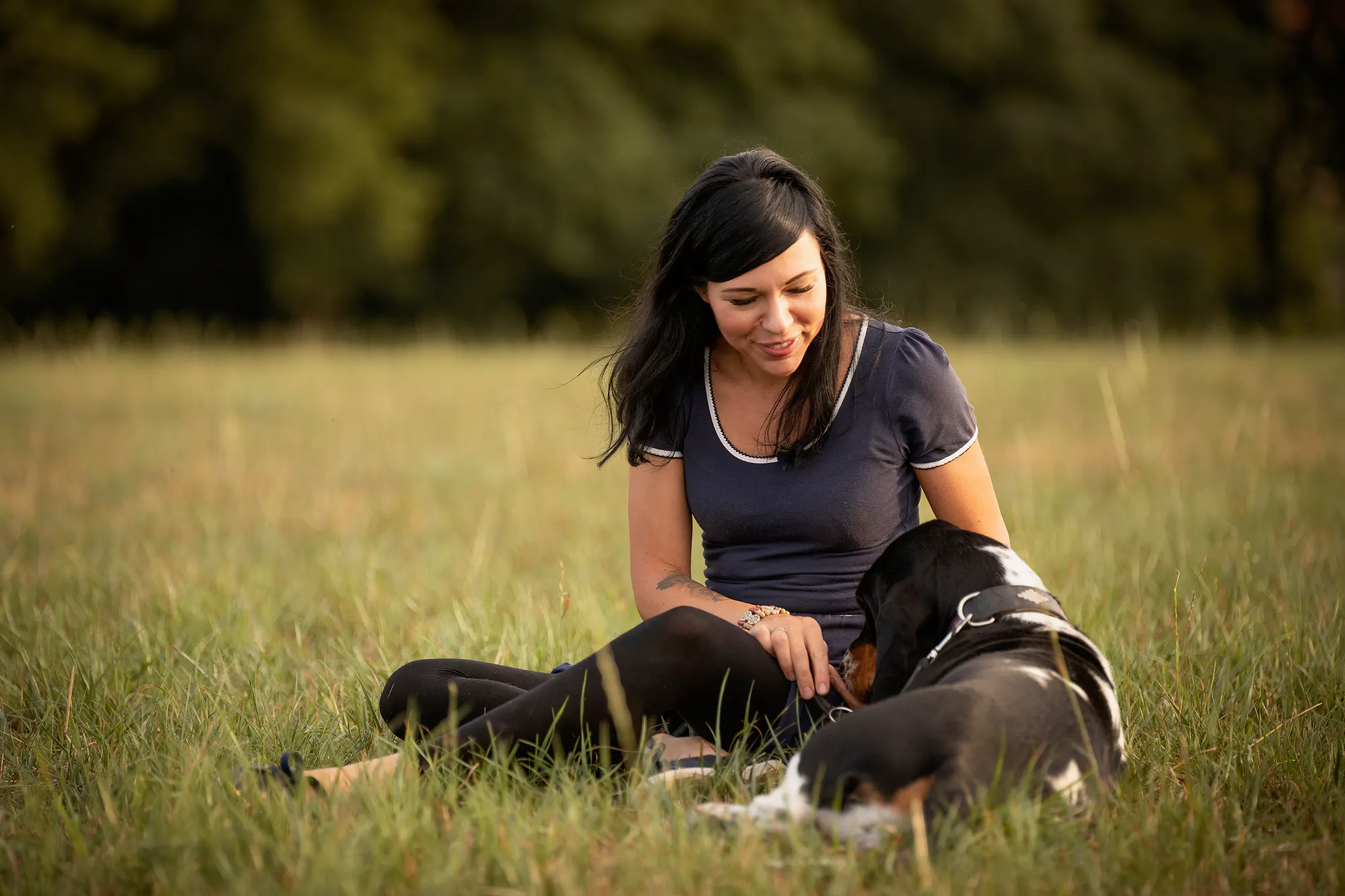
Michaela Blümchen: “If the question is about what becomes apparent during an animal communication session when a dog has lost its human, then I would say: first and foremost, grief – although it can take many different forms. Dogs and other animals grieve the loss of a beloved being as well. But just as with us humans, it is highly individual how they deal with this loss, how they express their grief and how much time they need to adjust to a changed life situation. Especially when a dog comes into a new home after the death of its human, it can therefore be very valuable to give the dog space for what it has experienced and what is occupying its mind. Sadness, uncertainty or longing may emerge – but so may entirely different emotions. I do not want to generalise here, because every dog processes a loss in its own way.”
Can a deceased dog still make contact with its human?
Michaela Blümchen: “From my experience and my spiritual understanding, the connection does not end with death. I believe that souls who have gone before us can continue to make contact with the people they love. This contact can manifest itself in many different ways and is sometimes very subtle. Some people report suddenly feeling warmth or cold at a particular moment, repeatedly encountering a certain number, or hearing a song on the radio that happens to play at exactly the right moment. White feathers or butterflies are also often perceived as such signs. Of course, from the outside, it is not always possible to say what is actually a sign and what is coincidence. What matters much more is what such a moment evokes within a person and whether they feel a connection to their deceased animal through it. Beyond that, it is possible to consciously seek contact with a deceased soul through a medium. This is also part of my work and, for me, it is repeatedly a very special and deeply moving form of animal communication.”
A dog once asked me: ‘Why do humans hate us so much?’
Are there dogs who still want to “communicate” something to their human after their death?
Michaela Blümchen: “Usually, it is initially the humans who still want to say something to their deceased animal or ask questions. But yes – the animals themselves also frequently have something they want to give to their humans during these conversations. Often, these are very loving messages. Many express gratitude for the time they shared or talk about what they particularly appreciated about their human. Sometimes, however, they are also very individual and surprisingly everyday things. Just today, for example, a deceased dog told me at the end of our conversation that his human companion should not let her knee problems hold her back. She laughed and confirmed to me that her knee really does cause her problems again and again. Those are exactly the kinds of moments that touch me deeply, because the messages are often so personal. It is not always about the great questions of life. Sometimes it is simply something that belongs precisely to that one person and the unique relationship between them and their animal.”
What is the most emotional message you have ever received from a dog?
Michaela Blümchen: “If by ‘emotional’ you mean which message affected me personally most deeply, then it was actually not a message, but a question. A dog once asked me: ‘Why do humans hate us so much?’ This dog had suffered unimaginable cruelty at the hands of humans. I do not want to go into the details, because I do not believe they are what is important about what shook me so deeply in that moment. It was that one question. It touched me deeply because, to me, it contained so much: his incomprehension, his sadness and, at the same time, the question of how a being that can place so much trust in us humans could possibly understand that people can cause it suffering. I will never forget moments like that. And they are also one of the reasons why I so strongly wish that we change the way we see animals and treat them with greater appreciation, compassion and respect.”
Can dogs know that they are going to die?
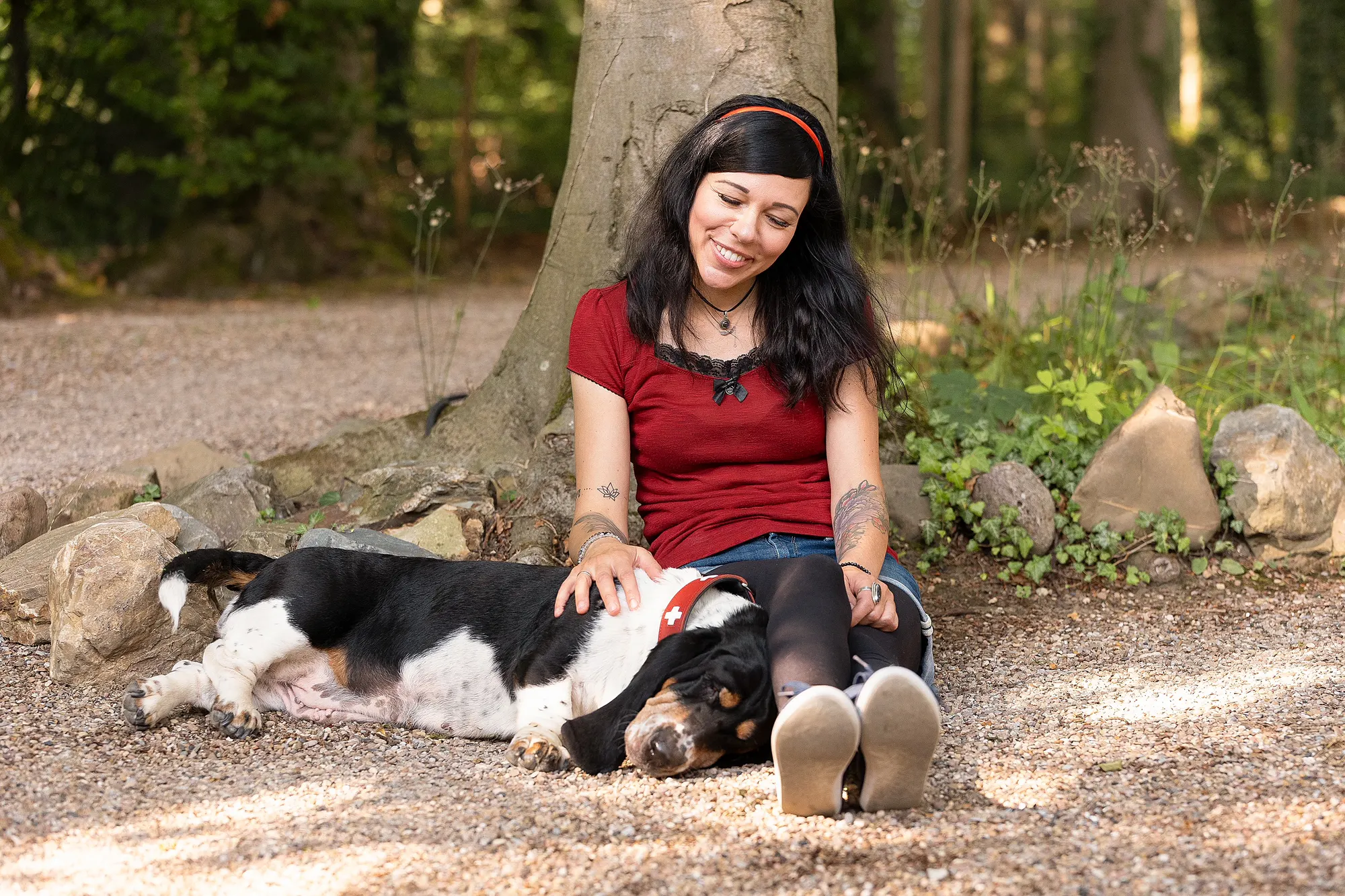
Michaela Blümchen: “Yes, some dogs seem to sense that they have begun their final journey. During conversations, I experience animals who very clearly perceive that their time is coming to an end and who, in a certain way, are already preparing themselves for it. But here too, there is no universal experience. Some animals die very suddenly and unexpectedly, without anything of the sort having appeared beforehand during the conversation. I therefore do not believe that every dog knows in advance that it is going to die. But I have certainly experienced dogs who gave me the impression that they were very clearly aware that their lives were approaching their end.”
Can a dog be afraid of death or do they perceive it differently from us?
Michaela Blümchen: “In my experience, animals often have a different relationship with death than we humans do. They seem to accept it much more naturally as part of a process that belongs to life. The way I experience animals, they can become very deeply immersed in the present moment – in what is happening right now. We humans often concern ourselves with what might happen and develop fears about a future that does not even exist yet. Animals often seem much more immediate to me in this respect. That does not mean that a dog can never be afraid of dying. But particularly with older or seriously ill animals who are in pain or whose bodies are becoming increasingly weak, I often experience death not as something threatening. Sometimes it is perceived more as letting go or as an end to physical suffering. Animals can teach us something through this very quality: not to see death exclusively as the opposite of life, but as something that, at some point, also becomes part of that life.”
Especially after the death of a beloved dog, a person’s thoughts can often begin to spiral: Did I choose the right moment? Could I have done something more? Did my dog know how much I loved them? Is there something that remained unsaid between us?
Are there cases in which a dog has given its human a reason for its behaviour that the human could not previously understand?
Michaela Blümchen: “That is, for me, one of the most beautiful possibilities of animal communication: it can help us perceive a situation from the animal’s perspective – and that perspective can be completely different from our own. I remember, for example, a female dog who barked every time she encountered other dogs while out walking. There could have been many obvious explanations for this: insecurity, aggression, protectiveness or the feeling that she needed to be on guard. But the dog conveyed something completely different to me. In essence, she said: ‘I am afraid that you might meet another dog and prefer them to me. I sense that I am only second place in your life.’ Her human companion then began to cry. She told me that her previous dog had died and that she had only taken this dog into her life afterwards. At the same time, she had to admit to herself that she had not yet been able to fully open her heart emotionally to the new dog. For me, it was a very moving moment because suddenly it became possible to understand what might have been behind the behaviour. And above all, something crucial happened afterwards: the human companion was able to interact with her dog differently. Their relationship changed – and eventually, the dog stopped barking at other dogs. Experiences like this are exactly why I believe it can sometimes be so valuable not to ask only, ‘How can I stop this behaviour?’ but first: ‘What are you trying to tell me through this behaviour?’”
Can animal communication help people come to terms with the loss of their dog?
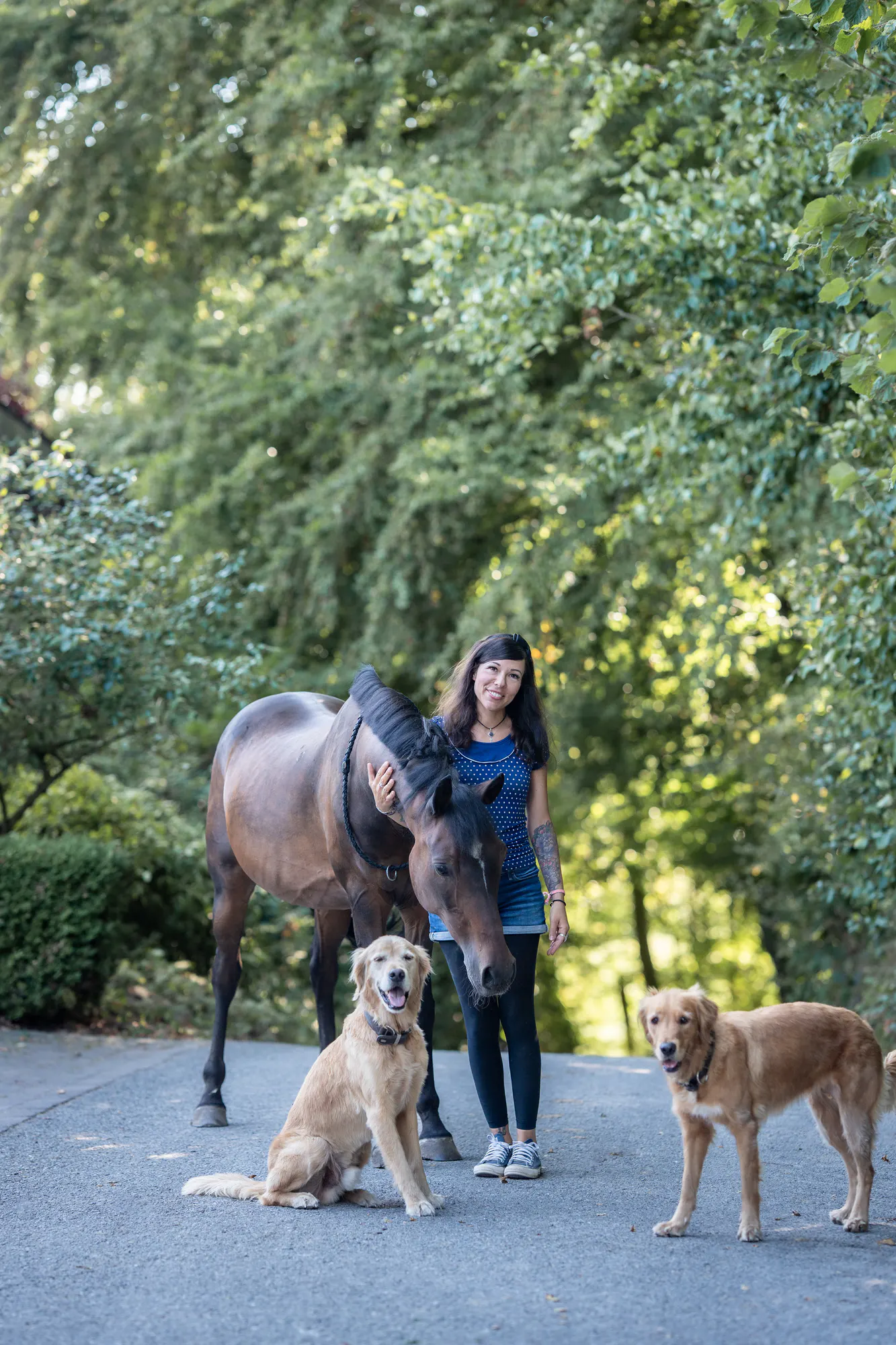
Michaela Blümchen: “Yes, in my experience, animal communication can help clarify questions that can sometimes occupy or even torment a person for a long time after losing their animal. Especially after the death of a beloved dog, a person’s thoughts can often begin to spiral: Did I choose the right moment? Could I have done something more? Did my dog know how much I loved them? Is there something that remained unsaid between us? An animal communication session can help find answers to such questions and, as a result, bring a little more peace into the grieving process. Sometimes, it can help quiet that constant stream of thoughts to some extent. However, I would not necessarily call it ‘moving on’ or ‘closure.’ Grief is deeply personal, and everyone deals with it differently. How someone uses the information from such a conversation as part of their grieving process is also entirely individual. For me, therefore, it is less about finding closure with a beloved animal and more about finding a way to continue living with the loss while preserving the connection to that animal in a different form.”
Is there anything you would like to talk about, something you feel is important for people to know?
Michaela Blümchen: “I am very grateful for this question because, for me, it touches upon the true core of my work. My vision is that we can recognise just how sensitive, intelligent, wise and unique animals are. That we stop underestimating them and begin to truly listen to them. And this is not only about the animals with whom we share our homes. A so-called farm animal does not feel any less than a dog or a cat. These animals also have needs, fears, preferences, relationships and their own individual personalities. The distinction between ‘pet’ and ‘farm animal’ is something we humans have created – to the animal itself, its life is no less valuable. I wish that one day it will become completely natural to communicate with animals. That animal communication can simply be accepted as something normal and that, through it, we can increasingly recognise how much we have in common with one another. For me, this is one of the greatest meanings of animal communication: the more genuinely we perceive animals, the harder it becomes to judge them solely according to their usefulness to us. I wish for a world in which we understand that, despite all our differences, we have one thing in common: We all feel. We all want to live. And every single life deserves respect.”